How to Pitch Claude to Leadership: The Compliance, Efficiency, and ROI Case That Actually Gets Approved
You already know Claude works. Getting leadership to approve it is a different problem — one you win by answering the risk question first, making the value concrete second, and putting the return in money third.
Builds and governs monday.com and Claude AI rollouts at Workiflow, a monday.com Platinum Partner and member of Anthropic's Claude Partner Network.
You already know Claude works. You have used it, and can name three things at your company it would fix by Friday.
And yet the pitch stalls. Not because anyone said no, but because the conversation drifts into "let us look at it next quarter." That is the version of no that nobody has to defend.
Here is what is actually happening in that room. You are making a value argument to people who are running a risk calculation. You are talking about what the company gains. They are quietly asking what happens if this goes wrong, whether client data ends up somewhere it should not, and whether they will have to explain a surprise line item to the board. Until those questions have answers, nothing you say about productivity lands.
So flip the order. Answer the risk question first, make the value concrete second, and put it in money third. This guide gives you the material for all three.
Part one: lead with compliance
This is the part most champions skip, and it is the reason most pitches stall. Compliance is not a footnote at the end of your deck. It is the thing that has to be settled before anyone can hear the rest.
The good news is that this is a strong hand to play. Here is what you can put in front of your security and legal teams, drawn from Anthropic's own documentation.
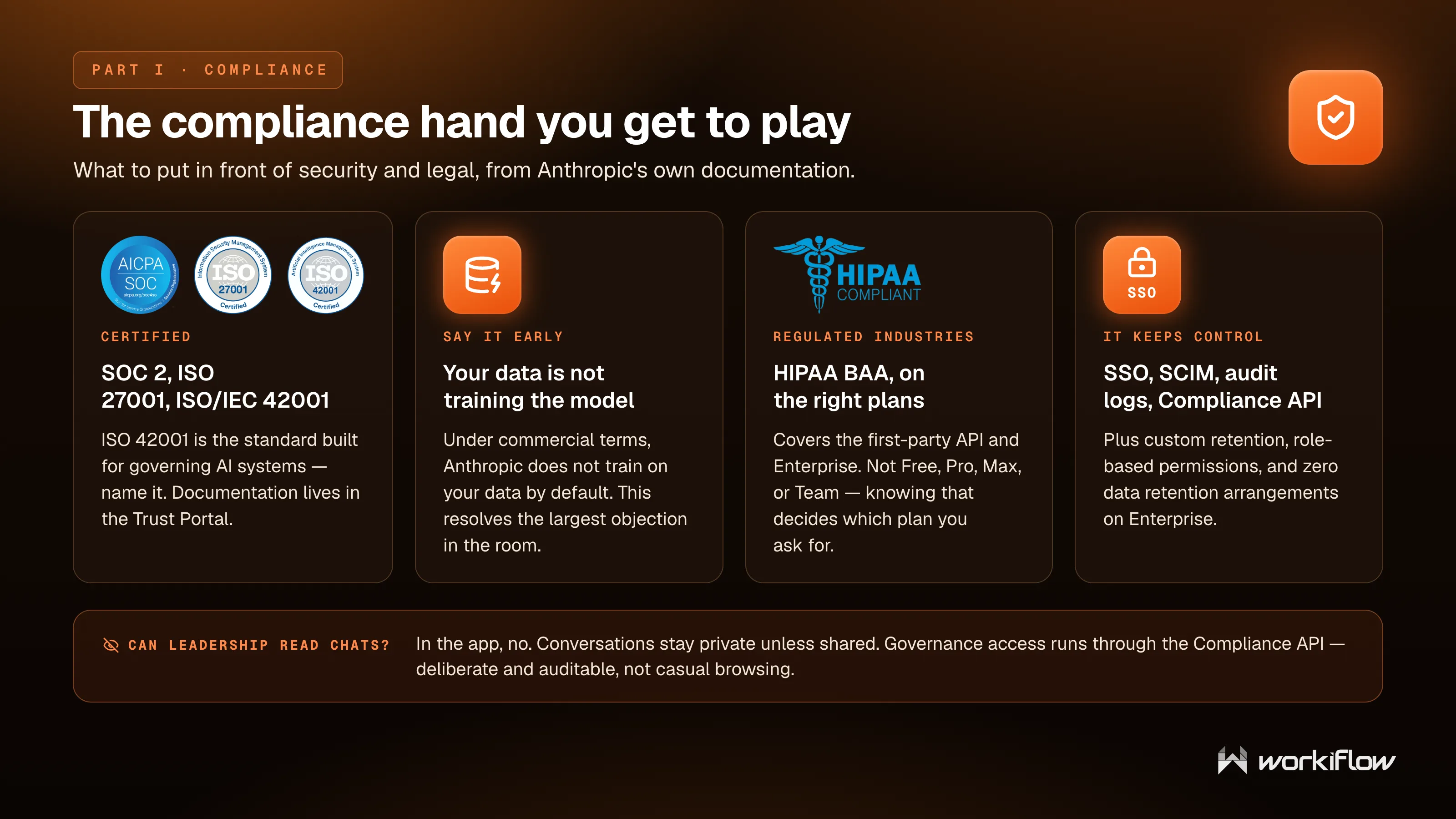
The certifications are in place. For its commercial products, which includes Claude for Work and the Anthropic API, Anthropic maintains SOC 2 Type I and Type II, ISO 27001:2022 for information security management, and ISO/IEC 42001:2023 for AI management systems. That last one is worth calling out by name in your pitch, because ISO 42001 is the standard specifically built for governing AI systems, and Anthropic was among the first frontier labs to certify against it. Compliance documentation is available through Anthropic's Trust Portal, which is exactly where your security team will want to go.
Your data is not training the model. Under commercial terms, Anthropic does not train its models on your data by default. For most organizations this single fact resolves the largest objection in the room. Say it plainly and early.
Regulated industries have a path. Anthropic provides a Business Associate Agreement covering HIPAA-ready services. Be precise here, because precision builds trust: the BAA covers the first-party API and Enterprise plans, and it is not available on Free, Pro, Max, or Team. If your organization handles protected health information, that detail decides which plan you are asking for, and knowing it before you walk in makes you look prepared rather than optimistic.
IT keeps real control. Enterprise plans give administrators the governance stack a security team expects: single sign-on through your identity provider, SCIM provisioning so removing someone from your directory removes their access, audit logs, custom data retention, role-based permissions, and a Compliance API that gives authorized security teams programmatic access to activity for auditing purposes. Zero data retention arrangements are available as well.
And here is the question that comes up in almost every one of these conversations. Can leadership read everyone's chats? In the app, no. Individual conversations stay private to the person who created them unless they choose to share them. That cuts both ways in your pitch, and both directions help you. Your executives are reassured that their own work is private, and your security team learns that governance-grade access on Enterprise runs through the Compliance API as a deliberate, auditable process rather than casual browsing.
What to actually hand them. Do not summarize the security posture yourself. Send your security team to the Trust Portal, name the certifications in your one-pager, and offer to bring in someone who can answer the technical questions live. Objections shrink fast when the person raising them gets to talk to someone who has done this before.
Part two: make the efficiency case specific
Once risk is off the table, you have their attention. Do not waste it on the word "productivity."
Leadership has heard that AI makes teams more productive. It means nothing to them, because it does not attach to anything they are responsible for. What lands is naming work they already know is slow, and showing them what it looks like when it is not.
Pick two or three jobs, not a category. Not "AI will help our operations team." Instead: the weekly client status report that takes someone most of a Thursday, the inbound leads that sit for two days because nobody is sure who owns them, the policy documents nobody can find so people ask three colleagues instead. Every leadership team has a shortlist of these. Use theirs, not a generic one.
Show it, do not describe it. The single most effective move in these pitches is a live demonstration on the company's own work. Take a real document, a real board, a real messy input, and run it. Ten minutes of that beats forty slides. Bring the output, not a promise of the output.
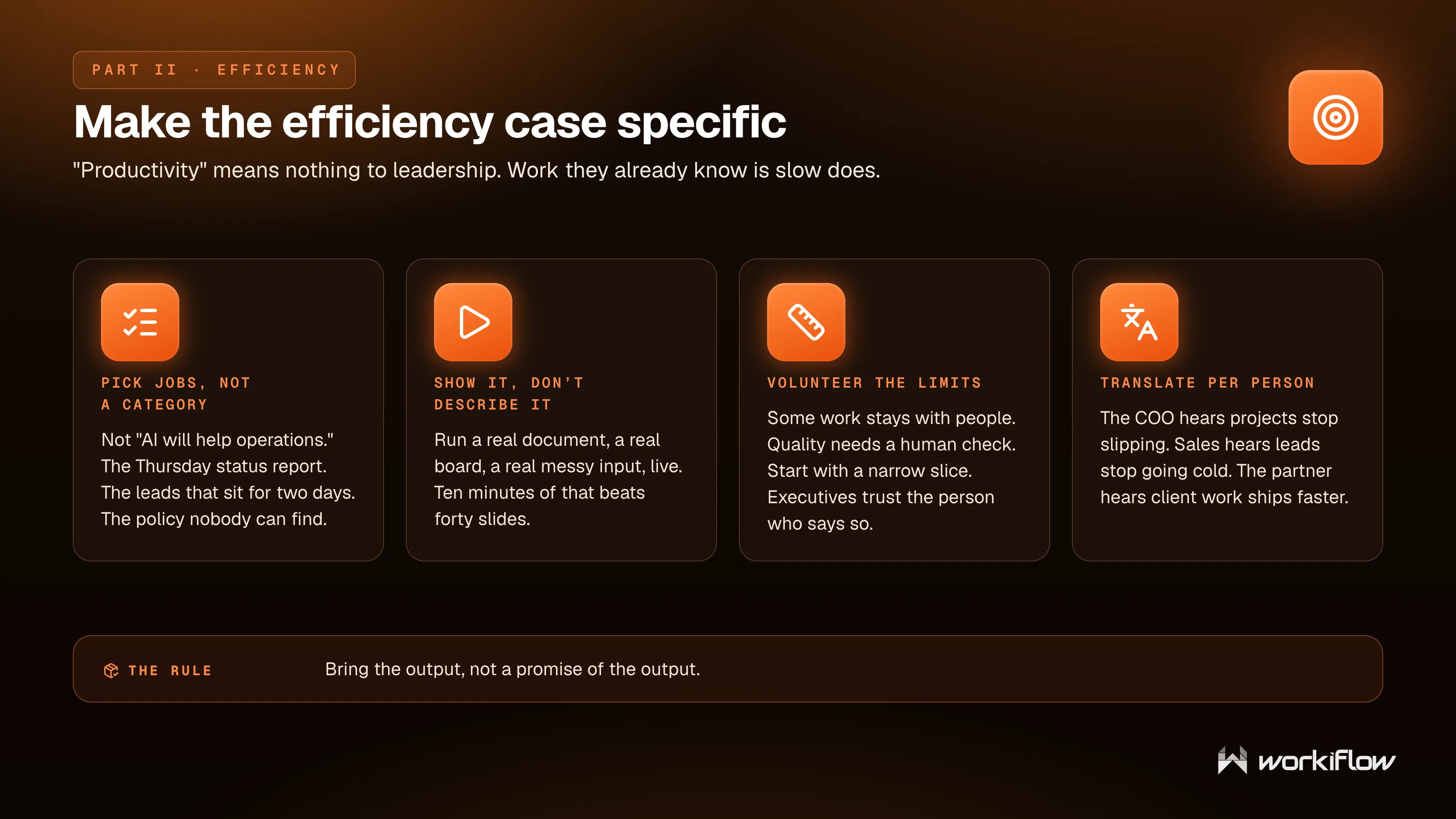
Be honest about where it fits. Credibility comes from knowing the boundaries. Say plainly that some work should stay with people, that quality still needs a human check, and that you would start with a narrow slice rather than everything. Executives have sat through enough oversold technology pitches to trust the person who volunteers the limits.
Name what changes for them personally. A COO cares that projects stop slipping. A head of sales cares that good leads stop going cold. A managing partner cares that client work goes out faster without more headcount. Translate the same capability into each person's language before you walk in.
Part three: put it in money, not hours
This is where most pitches quietly fall apart, and it is worth understanding why, because the standard changed recently.
Research from the Futurum Group's 2026 enterprise survey of more than eight hundred IT decision-makers found that direct financial impact, meaning revenue and profitability, nearly doubled as the primary metric for AI return, while productivity gains fell as the leading measure. Boards learned that hours saved do not automatically show up anywhere on the profit and loss statement. If your pitch ends at "this saves each person five hours a week," a good CFO will ask what happened to those five hours, and if you do not have an answer, the number stops counting.
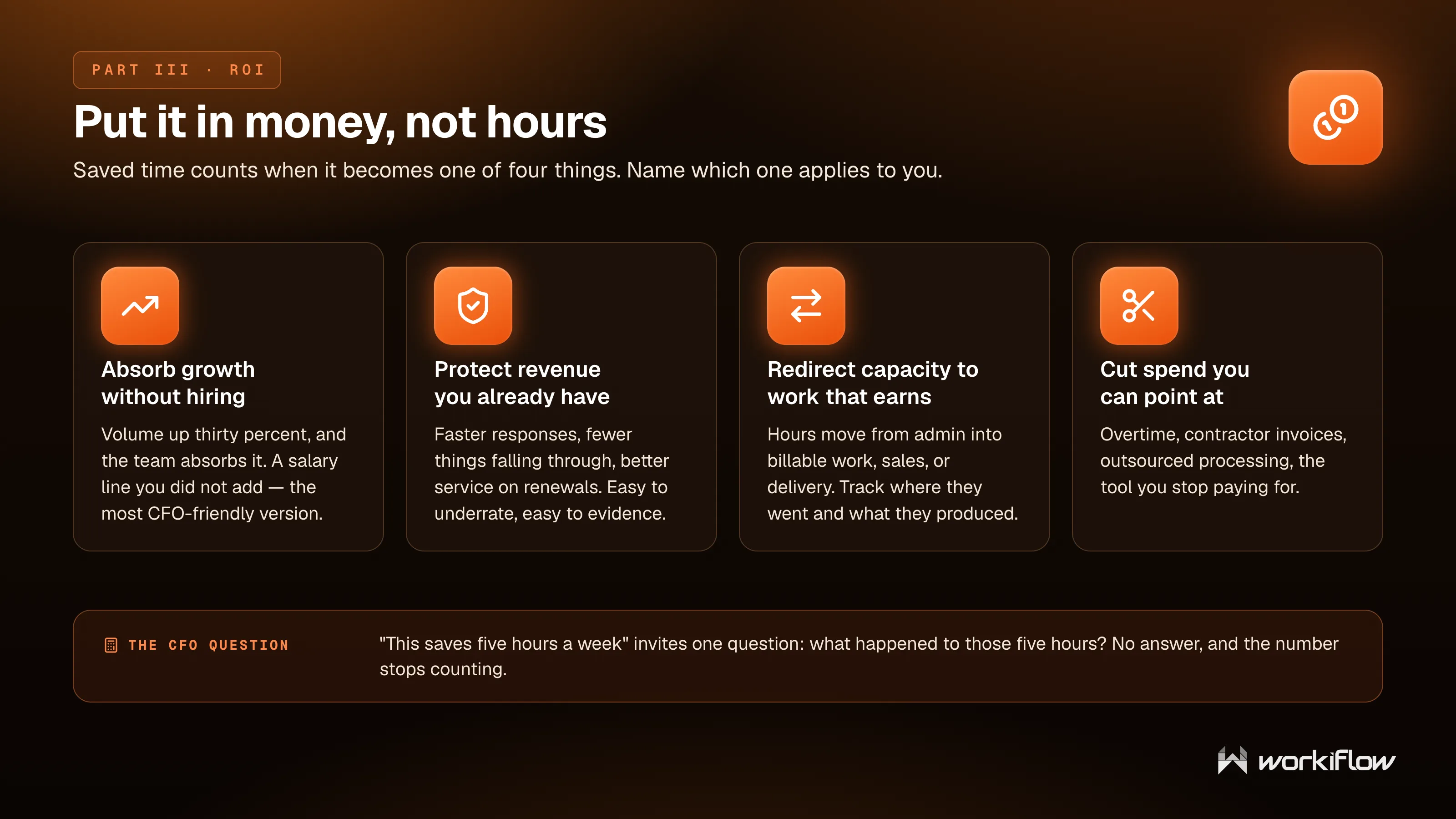
So convert it. Saved time becomes financial impact when it turns into one of four things, and your pitch should name which one applies to you:
Absorbing growth without hiring
Your volume is up thirty percent and you were about to add two people. If the work absorbs into the existing team, that is a salary line you did not add, and it is the most CFO-friendly version of this argument.
Protecting revenue you already have
Faster response times, fewer things falling through, better service on renewal accounts. This one is easy to underrate and easy to evidence.
Redirecting capacity to work that earns
The hours move from admin into billable work, sales conversations, or delivery. Track where they went and what they produced.
Cutting spend you can point at
Overtime, contractor invoices, outsourced processing, the tool you can stop paying for.
For external validation, the industry numbers are strong. Google Cloud's research on AI return found that among executives with AI agents deployed in production, seventy-four percent reported achieving return within the first year. PwC research found that around two-thirds of organizations using AI agents report measurable productivity improvements, and a majority expect returns above one hundred percent. McKinsey's global survey found that a large majority of organizations reported measurable return from at least one AI initiative.
Use those to show the direction of the market, then anchor on your own numbers. One honest internal estimate beats five impressive external ones.
And ask for a pilot, not a platform. The most approvable version of your pitch is small: one team, one or two use cases, a defined period, and a number you will report back on. A bounded pilot with a clear success metric is an easy yes, because it is easy to stop. A company-wide rollout is a decision, and decisions get deferred.
Putting the pitch on one page
If you take nothing else, take this shape. Open with the risk answer, because it is what they are actually thinking. Name two or three specific jobs, ideally ones they have complained about. Show a real output on real company work. Convert the value into money using one of the four conversions above. Close by asking for a small, time-boxed pilot with a metric attached and a date to review it.
That is a conversation leadership can say yes to in one meeting.
The objections you should expect
"Can our people see each other's work?"
No. Individual conversations are private to the person who created them unless shared. On Enterprise, governance access for security teams runs through the Compliance API as an auditable process.
"What if someone puts sensitive information in?"
Set the policy before the rollout, not after. Admin controls, role-based permissions, and workspace-level restrictions let you decide who can use what and where. This is a configuration question with a real answer, which is why it helps to have someone who has configured it before.
"How do we stop this from becoming an unpredictable bill?"
Admins can set spend limits at the organization and per-user level. Most cost surprises come from habits rather than pricing, and a short session on using the right model and keeping conversations focused usually saves more than any cap.
"What if it gives people wrong answers?"
Keep a person in the loop on anything that is client-facing or irreversible, at least at the start. That is standard practice in the deployments that work, not a sign of weakness in the technology.
Want help making the case internally ?
We do this with teams regularly, and we are happy to join the conversation with your leadership or your security team. As a monday.com implementation partner and a member of Anthropic's Claude Partner Network, we can walk your stakeholders through the compliance posture, help you choose the right plan for what you actually need, and scope a pilot with a metric that will hold up in the review. Book a free consultation with Workiflow and we will help you build the pitch.
Book a callFrequently asked questions
Start with compliance, because risk is the objection that quietly kills approvals. Then make the efficiency case specific by naming two or three jobs leadership already knows are slow and demonstrating a real output. Then express the value in financial terms rather than hours saved, and ask for a bounded pilot rather than a company-wide rollout.
For its commercial products, Anthropic maintains SOC 2 Type I and Type II, ISO 27001:2022 for information security management, and ISO/IEC 42001:2023 for AI management systems, with compliance documentation available through its Trust Portal. A Business Associate Agreement covering HIPAA-ready services is available on the first-party API and Enterprise plans, and not on Free, Pro, Max, or Team.
No. Under commercial terms, Anthropic does not train its models on your data by default. This is usually the single most important fact to state early in a leadership pitch.
Not in the app. Individual conversations remain private to the person who created them unless that person shares them. On Enterprise, a Compliance API gives authorized security teams programmatic access to activity for auditing and governance purposes, which is a deliberate, auditable process rather than casual browsing.
Enterprise plans include single sign-on through your identity provider, SCIM provisioning so directory changes propagate to access, audit logs, custom data retention, role-based permissions, and a Compliance API. Zero data retention arrangements are also available.
Convert time saved into financial impact. Show that it absorbs growth without new headcount, protects revenue you already have, redirects capacity into work that earns, or cuts spend such as overtime or contractor costs. Boards increasingly discount hours saved on its own, so name the conversion explicitly.
Small. One team, one or two use cases, a defined time period, and a success metric you will report on. A bounded pilot is easy to approve because it is easy to stop, while a company-wide rollout is a decision that tends to get deferred.
Administrators can set spend limits at both the organization and per-user level. In practice most overspend comes from habits, such as using the most powerful model for everything or keeping one enormous conversation running for weeks, so a short enablement session usually does more for cost than a hard cap.
Sources: Anthropic Privacy Center and Trust Portal (certifications, BAA scope, data handling), Anthropic support documentation (Enterprise plan controls, Compliance API), Futurum Group 2026 Enterprise Software Survey, Google Cloud ROI of AI research, PwC agentic AI research, and McKinsey global AI survey. Verified July 2026. Plan features and compliance scope change, so confirm current details against Anthropic's Trust Portal.